Snowden says leaks fuelled needed debate

Former intelligence contractor Edward Snowden says he has no regrets over his leaks about mass surveillance programs, saying they sparked a needed public debate on spying and data collection.

Snowden, who spoke via video link from Russia to the SXSW festival in Austin, Texas, said he revealed the programs of the US National Security Agency and other such services to foster 'a better civic understanding' about what had been secret programs.

He said his decision to leak documents to journalists 'wasn't so I could single handedly change the government; what I wanted to do was inform the public so they could provide their consent to what we should do.'

Snowden, a former NSA contractor who has been in hiding in Russia and has been charged in the United States with espionage, maintained that 'every society in the world has benefited' from the debate on surveillance.

'Regardless of what happens to me, this is something we have a right to know,' he said on the link with members of the American Civil Liberties Union, who noted that the hookup was routed through seven proxy servers to keep his location secure.

Snowden, who appeared against a backdrop of a giant copy of the US constitution, said the NSA programs have fundamentally altered the rights outlined in the charter.

'The interpretation of the constitution has been changed from no unreasonable searches and seizures,' to any seizure is fine, just don't search it,'' he said.

Snowden said he chose to speak to SXSW because he believes it is important to encourage technology companies to make changes to stem mass surveillance.

'The people who are in the room in Austin right now, they are the folks who can really fix things through technical standards,' he said.

Snowden said more companies should adopt robust encryption that is built into communications without users having to use complex technical tools.

See the rest here:
Snowden says leaks fuelled needed debate

At Home With Glenn Greenwald

At Home With Glenn Greenwald

http://motherboard.vice.com/read/meet-glenn-greenwald?trk_source=features1

http://youtu.be/hoCPdLh_FiQ

Before the Snowden revelations, the journalist Glenn Greenwald lived in Brazil with his husband, David Miranda, because American law didn't recognize their marriage. After the Defense of Marriage Act was struck down last June—the same month that Greenwald began publishing his reporting on Edward Snowden's revelations about the NSA—the couple faced a new reason not to relocate back to New York.

"The UK and US governments hate the journalism that we're doing," he told VICE at his home near Rio de Janeiro, regarding Miranda's 11-hour detention and questioning by authorities at an airport in London in July. He was held under an anti-terror law, which was "a way of saying look at what it is we can do to people who defy us if we choose."

In that injustice, however, Greenwald found a silver lining. "At the time that it happened, I was angry, I felt helpless, I was furious they would target someone peripheral to these events, instead of me or Laura or the other journalists with whom we've been working," he said. "But at the same time I found it incredibly emboldening. They showed their true face to the world, or to me, about how abusive they are when it comes to the exercise of their power. And that made me know just how compelling it was to continue to bring transparency to what it is that they're doing. And it showed how they can't be trusted to exercise power without transparency and accountability."

Greenwald's new media venture, First Look Media, backed by eBay founder Pierre Omidyar, carries with it the anti-establishment ethos that has marked his journey from lawyer to op-ed columnist to reporter for places like Salon and the Guardian. Amidst criticism of Omidyar and eBay, particularly over their record in defending privacy and press freedoms, Greenwald has insisted that First Look and its journalists, like Laura Poitras, Jeremy Scahill and Bruce Schneier, will have editorial independence to pursue stories about surveillance and other controversial topics. And it promises a new model for supporting independent journalism, with an organizational structure that combines a for-profit news technology company with a news non-profit.

"Over time I realized that you can only make an impact on any single political issue if you start understanding and confronting and ultimately subverting the patterns of how media institutions function," said Greenwald. "Once I really started engaging with media institutions, it was a gradual process by which I started understanding how journalism functions but also doing the kind of journalism that I thought was needed."

Greenwald doesn't want to call the US government a "tyranny," but he doesn't hesitate to say that with its surveillance power, it has the hallmarks of one. His concern for privacy, conversely, is rooted in his interest in human liberty.

"As psychological studies show, as all kinds of social science demonstrates, when you know you're being watched, you make choices that you believe that the judgment of society demands that you make," he said. "It's only when you can behave and choose and explore without judgmental eyes being cast upon you, that's really the realm where dissent and creativity and exploration exclusively reside."

"So there are all kinds of political dangers to having privacy eroded, but there also really significant harms on the human and individual and personal level," he continued. "And there aren't many people articulating its value or defending it from erosion, so I perceived this need of defense of this value that I consider to be most important."

The NSA Has Impersonated Facebook To Spread Malware

The NSA Has Impersonated Facebook To Spread Malware

Best find something else to do with your time other than FarmVille...

NSA-Book?

http://gizmodo.com/the-nsa-sometimes-masquerades-as-a-facebook-server-1542109879

So the NSA is spying on you. You've known that for quite some time now. What you might not know much about is exactly how they're doing, and a new report from Ryan Gallagher and Glenn Greenwald offers up some pretty grizzly details about the agency's worldwide, automated malware network.

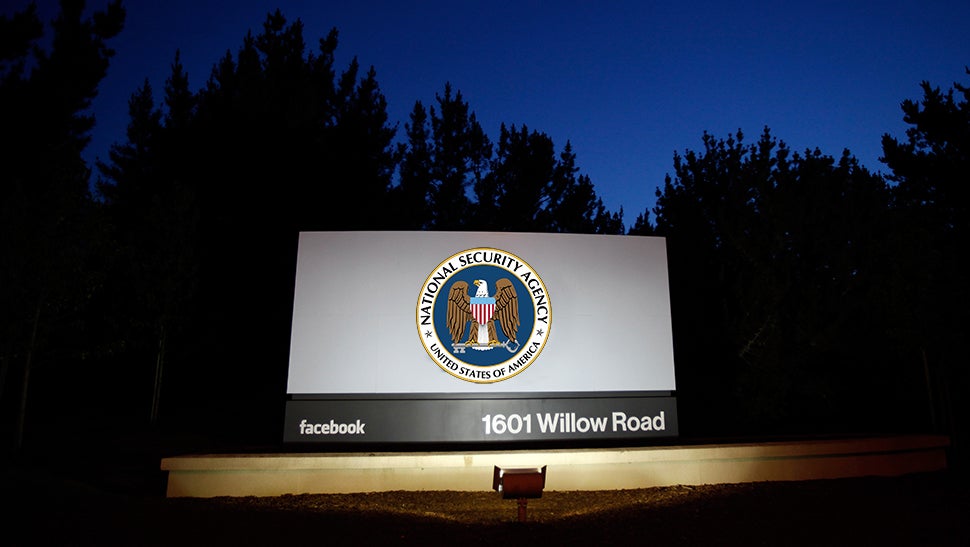
Did you know, for instance, that the NSA pretends to be Facebook sometimes? As Gallagher and Greenwald report, "In some cases the NSA has masqueraded as a fake Facebook server, using the social media site as a launching pad to infect a target's computer and exfiltrate files from a hard drive." That's a little extra worrisome when you consider the fact that Facebook has Like buttons spread across the entire internet, giving the NSA that many more chances for its malware to burrow into your hard drive.

This effort and the others described in the report are lead by the NSA's elite Tailored Access Operations (TAO) unit. We've heard about this unit before. Last year, Der Spiegel published an exposée on TAO, which one Gizmodo writer described as a "premier ninja hacking squad." The new report has some new details, including some on the specific tools the NSA uses to spy on you and your friends… and potential terrorists, too:

An implant plug-in named CAPTIVATEDAUDIENCE, for example, is used to take over a targeted computer's microphone and record conversations taking place near the device. Another, GUMFISH, can covertly take over a computer's webcam and snap photographs. FOGGYBOTTOM records logs of Internet browsing histories and collects login details and passwords used to access websites and email accounts. GROK is used to log keystrokes. And SALVAGERABBIT exfiltrates data from removable flash drives that connect to an infected computer.

So again, we knew that the NSA could tap into your computer's microphone. We also knew that the agency could access your camera and your log in details. The keystroke-logging thing actually sounds new, but nothing is surprising any more. The really alarming thing is just how detailed and well thought out this whole malware infection project has been. Didn't it cross anyones mind that masquerading as a Facebook server might be a bad idea?

There are no bad ideas at the NSA. Or so it seems. [The Intercept]

Update: It looks like Mark Zuckerberg noticed the news about the NSA pretending to be Facebook servers because hejust posted a rare note on his profile. The Facebook founder more or less scolds the government for screwing up the internet and humblebrags a little bit:

I've called President Obama to express my frustration over the damage the government is creating for all of our future. Unfortunately, it seems like it will take a very long time for true full reform.

Edward Snowden: ‘The NSA set fire to the internet. You are the firefighters’

Edward Snowden: 'The NSA set fire to the internet. You are the firefighters'

Snowden tells a packed audience that SXSW’s technologists are the people who can fix the deficiencies in the internet to protect standards

http://www.theguardian.com/technology/2014/mar/11/edward-snowden-sxsw-nsa-internet
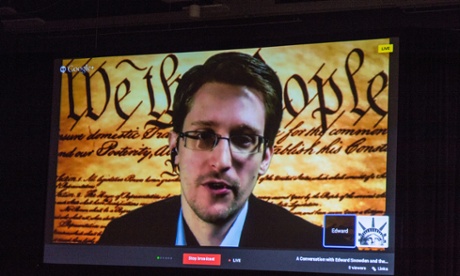
Edward Snowden speaks via Google Hangouts at SxSW in Austin, Texas

Edward Snowden chose to make his first public appearance since his spectacular ex-filtration of thousands of secret NSA documents to an audience of technology people at the annual SXSW Interactive festival in Austin, Texas on Monday.

It’s been a decade since I last spoke at SXSW, and the past 10 years have seen the conference swell an unbelievable (and at times, unmanageable) size, spilling out into the conference rooms of nearby hotels and venues. The exact cause of this spectacular growth is hard to put your on. In part, it may just be an instance of the network-effect phenomenon that has caused other counter-culture/tech events like Comic-Con and Burning Man to grow to bursting – but it’s clear that many of the bright young geeks in attendance are here because they’re chasing the legendary SXSW break-out effect that is credited with bringing Airbnb, Twitter and Foursquare to global prominence.

Everybody would like to talk to Snowden, from politicians (he provided a testimony to an EU committee examining mass surveillance last week) to book agents (he is a crisp and engaging writer with a flair for writing that is memorable without being showy) to movie people. But Snowden chose to talk to nerds.

Snowden was beamed into the packed ballroom – as well as several satellite rooms and as many as a million viewers on a livestream – by means of a Google Hangout video-chat, his image and voice thoroughly glitched-out by a journey through seven proxies. He appeared as a jittery, semi-frozen Max Headroom bust against a chromakeyed background of the First Amendment, his voice an inconsistent gargle.

This was not an easy technical feat. Washington Post journalist Barton Gellman and I were Snowden’s opening act, and there was a lot of nervous backstage joking before we went on as ACLU technologist Christopher Soghoian wrestled with the Snowden link. Soghoian and the ACLU’s Ben Wizner took the stage after Gellman and I stepped down, vamping for a few minutes while the bugs were ironed out, and then Snowden appeared, to thunderous applause.

Snowden quickly explained why he’d opted to speak to this audience: SXSW’s technologists were “the people who can really fix” the deficiencies in the internet and its applications “to enforce our rights and protect standards, even though Congress hasn’t gotten to the point of doing that.” Spies have treated the internet as “an adversarial global freefire scenario, and we need to protect people against it. The NSA has advanced policies that erode Fourth Amendment protections through the proactive seizure of communications. This demands a policy response, but we need a technical response from makers. The NSA is setting fire to the future of the internet and you guys are the firefighters.”

And we were off.

Serious security tools are notoriously hard to use

The mainstream debate over internet surveillance has focused on privacy breaches. At last, the privacy advocates who’ve spent decades trying to get internet users exercised about their privacy, Snowden’s revelations have prompted 86% of American internet users to take a step toward protecting their privacy. Alas, almost everything that a nontechnical person might do to make his internet experience more private will be useless.

That’s because all the serious security tools are notoriously hard to use. Snowden and Soghoian called on toolmakers to make their products “secure out of the box.” They both emphasised the need to make the security features of common internet technologies easier, with Snowden singling out Moxie Marlinspike’s startup Whisper for praise for its work in improving the user experience and user interface for cryptographic tools.

But as Soghoian pointed out, the majority of internet users will not download a program to replace the defaults that come with their devices, nor will they change the default configurations of those apps. However, when internet giants can be convinced to switch on cryptographic protection for the link to their users’ browsers, millions can benefit without ever having to take any action. And if the giants can’t be convinced, they can be shamed – as Yahoo was when Barton Gellman and Ashkan Soltani splashed the news of their laxness on the front page of the Washington Post last October, resulting, finally, in the company going to more secure defaults in January 2014.

Soghoian pointed out that everyone had something to worry about when it came to mass surveillance: “The government has collected a massive database of everyone’s private communications: everyone who’s called abortion clinic, everyone who’s called Alcoholics Anonymous, everyone who’s called a gay bookstore. Many Americans don’t want this stored. Whatever your politics, you know that your call to a church or gun store is not the government’s business. The person who sits in the Oval Office changes every few years and the person who sits there next may not be someone who you like.”

But privacy is only the surface of the NSA leaks. For cryptographers and many civil libertarians, the real worry is the integrity of the internet itself. All three speakers railed against the NSA’s programme of sabotaging security standards as well as the security of networks and networked devices.

Snowden described the unique recklessness of an American intelligence agency undermining internet security. “Our country’s economic success is based on our intellectual property – our ability to create, share, communicate and compete. Since 9/11, former NSA director Michael Hayden and current NSA director Keith Alexander have elevated offense at the expense of defense of our communications. They’ve eroded protection of our communications at the expense of defense of our communications.

“This is a problem because America has more to lose than anyone else when every attack can succeed. When you’re the country whose vault is more full than anyone else’s in the world it doesn’t make sense to attack all day without defending. It doesn’t make sense to weaken standards on vaults worldwide to create a back door that anyone can walk into. This weakens our national security and everyone else’s because we all rely on the same standards.

“Without security, we have nothing. Our economy can’t succeed.”

Soghoian made sure that the commercial implications of this were not lost on the entrepreneurial types in the audience, those who’d come to SXSW hoping to win the tech lottery. “Google, Yahoo and other internet companies want to sit between the conversations you have with your friends and add value. They want to mine your information, tell you about restaurants and suggest things that help you. That business model is incompatible with your security, with your having a secure, end-to-end connection to your friends.

“The irony of the fact that we’re using Google Hangouts to talk to Edward Snowden isn’t lost on me. End-to-end secure video conferencing tools aren’t polished. They’re not good enough to bounce traffic through seven proxies. In many cases, you have to choose between tools that are easy, reliable and polished and tools that are secure, but hard to use.

“Big companies have hundreds of developers to put on to user interface design. That’s not try of companies that are optimised for security. Those tend to be made by geeks, for geeks. But small developers can play a role. The next Twitter or WhatsApp should be both encrypted end-to-end and usable.

“Remember, adding security is easier for new companies than it is for the big incumbents. The big guys can’t deliver security to their users, because they’re hampered by their business-models. You can tell customers that if they give you $5 a month for encrypted communications, no one will be able to watch them. Many people will be willing to pay for that.”

But end-to-end security isn’t just good for privacy: it’s also a way of nudging spies and police toward proportionate surveillance. Snowden pointed out that suspects who use end-to-end security aren’t immune to spying, but they can only be surveilled through targeted, intensive attacks against their computers and phones. The expense of these attacks ensure that spies target people specifically in a way that is “more constitutional and more overseen,” since each event will be more visible to judges and oversight committees.

“Mass surveillance isn’t effective,” Snowden said. “We spied on everyone and found it didn’t work.” But contractors like Snowden’s former employer Booz Allen found mass surveillance contracts to be so lucrative that they lobbied for its continuation. As a result, surveillance resources were deployed without regard to real threats, meaning that specific, repeated warnings about Umar Farouk Abdulmutallab (the underwear bomber) and the Tsarnaev brothers (the Boston Marathon bombers) fell through the cracks.
‘We had an oversight model that could have worked’

Web inventor Tim Berners-Lee had the honour of asking the first question, asking Snowden how he’d change the web to make it more accountable, given the reality that spies will always try to collect information.

Snowden acknowledged that this was a complex problem, with lots of moving parts, made more complex by the secret nature of spy agencies. Still: “We had an oversight model that could have worked” – meaning the Congressional and judicial oversight systems for the NSA – “But the overseers weren’t interested in oversight – the Senate and House intelligence committees championed surveillance. James Clapper lied, and the congressmen who knew he’d lied allowed Americans to believe he’d told the truth.”

He went on to condemn the secret Foreign Intelligence Service Act Court, “a secret rubber-stamp court” to approve spying warrants. He said that the court was secret because the government had an interest in not tipping off suspects, but that a court shouldn’t interpret the constitution with only the NSA’s lawyers present to present arguments. He called for public advocates, “trusted public figures, civil rights champions to advocate for us. To tell us, these guys are lying to you. Otherwise how can we vote? Without information we can’t consent.”

For the remainder of the questions and remarks, Snowden and his co-panelists returned to technical questions, emphasising the fact that technology is the first line of defense for internet users.

Snowden reminded the technologists in the room that “Crypto works. It’s not an arcane black art. It is a basic protection, the Defense Against the Dark Arts for the digital world. We must implement it, actively research it,” going on to ask the audience to take on “a moral, philosophical and technical commitment to enforce and defend our liberties.”

Soghoian contrasted the importance of cryptography with the risk that internet users were exposed to by the NSA and GCHQ’s programmes of security sabotage. He was withering on the subject the NSA’s undermining of the US National Institute for Standards in Technology’s cryptography projects, saying it had “radicalised mild-mannered cryptographers. Consumers don’t choose their cryptographic algorithms, the people who choose them are the cryptographers. Those people are
really pissed and they should be mad.

“But they can make a difference. It’s a good sign that they’re mad. The tools that come out in a year or two will be more secure, because the tech community feels it was lied to.”

Snowden addressed the global audience, reiterating that the US has more to lose form being hacked, but “every citizen, every country has something to lose form unwarranted, unjustified surveillance of our private lives. If we don’t resolve these issues, if the NSA isn’t restrained, every government will treat their actions as a green light to do the same.

“Governments have stopped talking about the ‘public interest’ and started talking about the ‘national interest’. When these diverge, something is wrong.

“Would I do this again? Absolutely yes. No matter what happens to me. I took an oath to support and defend constitution and I saw it was being violated on a mass scale. The interpretation of constitution had been changed in secret from ‘no unreasonable search and seizure’ to ‘any seizure is fine, just don’t search it.’ That’s something the public had the right to know.”

Snowden’s video feed winked out to a standing ovation.

Woz: Snowden is a hero and Apple is the purest of all

Speaking at CeBit in Germany, Apple's co-founder says he understands why some think Edward Snowden is a traitor, but he's not one of them. Moreover, he believes Apple is the purest of all the tech companies.

Speaking from the heart, as always.

I don't want to go all Apple vs. Microsoft on you, but we have a national security situation.

The eminences grises of these two famous companies have come out on opposing sides of one of today's great political debates.

Earlier this week, Microsoft's Bill Gates told Rolling Stone of Edward Snowden: "I think he broke the law, so I certainly wouldn't characterize him as a hero."

Just in case you didn't quite get what he was saying, he added: "You won't find much admiration from me."

However, on Thursday, Apple co-founder Steve Wozniak seemed brimming with admiration.

As the Times Of India reports, he was speaking at the CeBit conference in Germany and offered this perspective: "He is a hero to me, but he may be a traitor to other people and I understand the reasons for them to think that way."

Why, then, should the NSA whistle-blower be seen as today's Robin Hood of information?

Woz continued: "I believe that Snowden believed, like I do, that the US has a right to freedom. He had the guts to and courage to sacrifice his life for a principle."

Follow this link:
Woz: Snowden is a hero and Apple is the purest of all

Edward Snowden wants easy to use encryption everywhere

SURVEILLANCE WHISTLEBLOWER Edward Snowden has taken part in a video conversation at the South By Southwest (SXSW) conference and called for more accessible encryption tools.

The subject of the conversation, which was hosted by the American Civil Liberties Union, was whether communications are secure and if they can be trusted. They can, said Snowden, but only with some third party help and the use of end to end, machine to machine encryption.

The use of strong encryption is key and the panel agreed that Snowden's revelations have improved the security landscape. The whistleblower said that technology companies need to help make encryption more accessible and less complex. "Encryption does work," he said, calling it "the defence against the dark arts for the digital realm."

Snowden said that the US National Security Agency (NSA) has created an "adversarial internet". He added that while policy changes are needed, technological changes will be the most effective.

"[We must] craft solutions that are safe", he said. "End to end encryption makes bulk surveillance impossible. There is more oversight, and they won't be able to pitch exploits at every computer in the world without getting caught."

He said that there has already been "a lot of progress" but added that systems are still too complex. "If you have to go a command line, people aren't going to use it."

Snowden called on attendees, the technical people who work for these companies, to play their parts. "You guys are all the firefighters, and we need you to help us fix this," he said.

When he was asked to recommend tools that the man in the street could use, he recommended TOR, which the other two would not support because they said it lacks ease of use.

As for claims from some quarters that his surveillance revelations have done harm, Snowden disputed this, and said that before the government focused on attacking, and that "leaks improve security".

He added that mass surveillance led to a lack of focus and missed leads. "We've had tremendous [intelligence] failures," he pointed out. "We spent all this money, we spent all this time hacking into Google's and Facebook's back end to look at their databases," he said. "What did we get out of that? We got nothing... We need policy advocates and public oversight. We need a watchdog that watches Congress."

Continued here:
Edward Snowden wants easy to use encryption everywhere