Journalists Who Broke News on N.S.A. Surveillance Return to the U.S.

Journalists Who Broke News on N.S.A. Surveillance Return to the U.S.

http://news.yahoo.com/2-reporters-probed-nsa-surveillance-back-us-165212692.html

NEW YORK (AP) — Two reporters central to revealing the massive U.S. government surveillance effort returned to the United States on Friday for the first time since the story broke and used the occasion to praise their exiled source: Edward Snowden.

Glenn Greenwald and Laura Poitras of The Guardian became a story of their own amid speculation they could be arrested upon arriving at Kennedy Airport. They were instead confronted by only reporters and photographers before fighting through traffic en route to a midtown Manhattan hotel to receive a George Polk Award for national security reporting.

In remarks before an audience of other journalists and editors, the pair credited the courage of Snowden, the former NSA contractor who leaked the information for their story.

"This award is really for Edward Snowden," Poitras said.

Greenwald said, "I hope that as journalists we realize not only the importance of defending our own rights, but also those of our sources like Edward Snowden."

The pair shared the award with The Guardian's Ewen MacAskill and Barton Gellman, who has led The Washington Post's reporting on National Security Agency surveillance. Revelations about the spy programs were first published in the two newspapers in June.

At the airport, Greenwald said he and Poitras were not "100 percent sure" they could enter the U.S. without being arrested. He said lawyers had been seeking assurance from the Justice Department "and they purposefully wouldn't give them any information about whether we were the target of a grand jury or whether there was already an indictment that was under seal."

Still, Greenwald said he "expected that they wouldn't be that incredibly stupid and self-destructive to try and do something that in the eyes of the world would be viewed as incredibly authoritarian."

After the award ceremony, Greenwald told reporters that he still speaks regularly to Snowden, who was granted asylum in Russia for a year. He said Snowden was aware Greenwald and Poitras were to be honored in New York and "was very supportive of that."

Republican U.S. Rep. Peter King, who leads the House Homeland Security subcommittee on counterterrorism and intelligence, called Greenwald "a disgrace to journalism and the country."

"No American should give Glenn Greenwald an award for anything," he said.

Snowden has been charged with three offenses in the U.S., including espionage, and could face up to 30 years in prison if convicted.

The disclosures have led to proposed overhauls of some U.S. surveillance programs, changes in the way the government spies on foreign allies, additional disclosures to defendants in some terrorism cases and demands from private companies to share details about government cooperation with their customers and shareholders.

Journalist alleges Ed Snowden claims CIA spies on charity organisations

Journalist alleges Ed Snowden claims CIA spies on charity organisations

Two of the journalists who helped the whistleblower Edward Snowden leak thousands of secret American documents are due to fly into New York later tonight - their first attempt to enter the USA since the story broke. Glenn Greenwald and Laura Poitras are hoping to to accept a prestigious journalism award for national security reporting. Mr Greenwald's partner David Miranda was detained at London's Heathrow last August and had his electronic equipment taken, before being released after a press outcry.

MARK COLVIN: Two of the journalists who helped the whistleblower Edward Snowden leak thousands of secret American documents are due to fly into New York later tonight - their first attempt to enter the USA since the story broke.

Glenn Greenwald and Laura Poitras are hoping to accept a prestigious journalism award for national security reporting.

Mr Greenwald's partner David Miranda was detained at London's Heathrow last August and had his electronic equipment taken before being released after a press outcry.

Meanwhile Edward Snowden himself appeared via video link before the European Council this week and said the American National Security Agency - the NSA - spied on major human rights organisations.

Luke Harding of the Guardian reported that story and he's the author of a new book, 'The Snowden Files'.

I asked him about the allegations of spying on organisations like Amnesty.

LUKE HARDING: We don't have the details, but what we do know about the NSA and human rights organisation is that, according to Edward Snowden, Skyped him from Moscow, the NSA is spying on human rights organisations: big ones, small ones, American ones.

He didn't actually name names, but he was asked specifically by a group of Council of Europe members whether the US was essentially eavesdropping on this highly sensitive communications of human rights groups like Amnesty International and Human Rights Watch, and he gave an emphatic answer: yes, absolutely they are, including within the borders of the United States.

MARK COLVIN: And Ken Roth of Human Rights Watch was actually in Australia during the last two weeks. He would have been spied on here then?

LUKE HARDING: One doesn't know, I mean we haven't seen the documents. It's highly possible. What we do know is that the NSA has a voracious appetite for all sorts of information and that it's kind of objective, it's kind of global objective, if you like, is to collect of the signals all of the time, in the words of General Alexander, the head of the NSA who's just retired.

In other words, they want everything. They want everybody's metadata; they want telephony records; they want the lot, and of course human rights organisations which work in some tricky parts of the world and have some quite interesting partners are a fairly obvious target.

But having said that, the way we've been covering this story, we journalists, Edward Snowden's media partners: the Guardian, New York Times, Spiegel and others, is that we've tried to get all the documents. In other words, we've only reported really what we've been able to prove and verify and which we think is in the public interest.

But, clearly, spying on human rights organisations is a matter of public interest.

MARK COLVIN: Well he also talked about a program called XKeyscore, which the NSA and its partners, which include Australia's intelligence agencies use to trawl through metadata. Could you explain a bit about that?

LUKE HARDING: It's a complex program. It's also an extremely powerful program. What was quite interesting about this is that this is something we wrote about, the Guardian, back in July of last year in a long story written by Glenn Greenwald, who then of course was working for us - now, isn't anymore.

But, in essence, it's a very powerful device which allows analysts, including Snowden, who said that he'd done this himself, to pick a selector if you like, which means a sort of keyword, and to search accordingly through vast quantities of emails, web chats, metadata - which means the who you're sending the email to, their address, your address and so on. And, I don't know if you remember, but at one point last year, Edward Snowden said that he, sitting at his desk, could actually search the private communications of everybody, including the president of the United States if he had a private email address for him.

Now the NSA have poo-pooed this and said this is not true. But it's clearly, according to Snowden on Tuesday, XKeyscore is the tool which allows essentially the NSA to surveil everybody on the planet.

MARK COLVIN: And, there's a been a lot of argument recently, particularly with police and intelligence agencies, arguing that they should have more access to metadata. Now, others are fighting back and saying that metadata can give those agencies a window into pretty much your whole life.

Who's right about that?

LUKE HARDING: I'm afraid the critics are right. Metadata is incredibly revealing. We're talking about what you search online; we're talking about who you contact; we're talking about people who, in the privacy of their own homes, will reveal their sexual orientation perhaps, their political affiliation, their religious views, who they're in contact with, using metadata - the record of your electronic transactions.

You can construct a rich electronic narrative of an individual's life: their predilections, their secrets, their joys, their sorrows. It's all there and, really, the spies are being disingenuous when they say, "Oh, it's not content; it doesn't count."

They can know practically everything about you.

MARK COLVIN: When Edward Snowden was talking to the Council of Europe, by what means was he talking and was it controversial that he was talking?

LUKE HARDING: The Council of Europe invited him and he spoke. The European Parliament, which is a slightly different body wanted to do this, but had chickened out in the end. I think that what's quite interesting is that we've seen a lot of online chats from Snowden in the past few weeks.

He's spoken to a couple of technology conferences in the United States. He spoke to an Amnesty International conference recently, and now he's talked directly to Europe, to this important human rights body, and I think that it's a sort of strategy change by Snowden who really for the first six months when he was stuck in Moscow, was pretty reclusive. He didn't meet anybody apart from his family. He met one reporter, Barton Gellman from the Washington Post in December.

But, since the beginning of this year, I think we've seen him try and make his case more and I think the strategic goal is actually to change the political climate in the United States so that, at some point, the White House - maybe not this White House - maybe a future White House will be in a position to give him clemency.

MARK COLVIN: Journalist, Luke Harding. His book is called 'The Snowden Files'.

Silicon Valley could force NSA reform, tomorrow. What’s taking so long?

Silicon Valley could force NSA reform, tomorrow. What's taking so long?

Tech CEOs are complaining, but bills are languishing. Time for internet companies to pull an OKCupid and call out the NSA, on every homepage

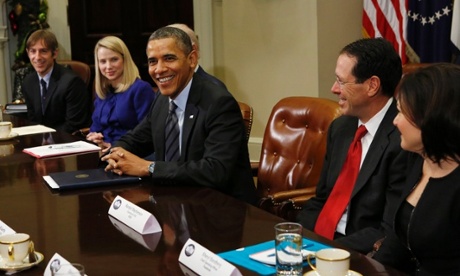
CEOs from Yahoo to Dropbox and Microsoft to Zynga met at the White House, but are they just playing for the cameras?

With Glenn Greenwald and Laura Poitras triumphantly returning to the US to accept the Polk Award with Barton Gellman and Ewan MacAskill yesterday, maybe it's time we revisit one of their first and most important stories: how much are internet companies like Facebook and Google helping the National Security Agency, and why aren't they doing more to stop it?

The CEOs of the major tech companies came out of the gate swinging 10 months ago, complaining loudly about how NSA surveillance has been destroying privacy and ruining their business. They still are. Facebook founder Mark Zuckerberg recently called the US a "threat" to the Internet, and Eric Schmidt, chairman of Google, called some of the NSA tactics "outrageous" and potentially "illegal". They and their fellow Silicon Valley powerhouses – from Yahoo to Dropbox and Microsoft to Apple and more – formed a coalition calling for surveillance reform and had conversations with the White House.

But for all their talk, the public has come away empty handed. The USA Freedom Act, the only major new bill promising real reform, has been stalled in the Judiciary Committee. The House Intelligence bill may be worse than the status quo. Politico reported on Thursday that companies like Facebook and are now "holding fire" on the hill when it comes to pushing for legislative reform.

The keepers of the everyday internet seem to care more about PR than helping their users. The truth is, if the major tech companies really wanted to force meanginful surveillance reform, they could do so tomorrow. Just follow the example of OKCupid from last week.

Mozilla, the maker of the popular Firefox browser, was under fire for hiring Brendan Eich as CEO because of his $1,000 donation in support of Prop 8 six years ago, and OKCupid decided to make a political statement of its own by splashing a message criticizing Mozilla before would-be daters could get to OKCupid's front page. The site even encouraged users to switch to another browser. The move made the already smoldering situation explode. Two days later, Mozilla's CEO was out of a job, and OKCupid got partial credit for the reversal.

The leading internet companies could easily force Congress' hand by pulling an OKCupid: at the top of your News Feed all next week, in place of Monday's Google doodle, a mobile push alert, an email newsletter: CALL YOUR MEMBER OF CONGRESS. Tell them to SUPPORT THE USA FREEDOM ACT and tell the NSA to stop breaking common encryption.

We know it's worked before. Three years ago, when thousands of websites participated in an unprecedented response to internet censorship legislation, the Stop Online Piracy Act (Sopa), the public stopped a once-invincible bill in its tracks. If they really, truly wanted to do something about it, the online giants of Silicon Valley and beyond could design their systems so that even the companies themselves could not access their users' messages by making their texting and instant messaging clients end-to-end encrypted.

But the major internet outfits were noticeably absent from this year's similar grassroots protest – dubbed The Day We Fight Back – and refused to alter their websites à la Sopa. If they really believed the NSA was the threat so many of them have claimed, they'd have blacked out their websites in protest already.

In an emblematic moment for the nonchalance at the executive level of tech companies, Dropbox named former Secretary of State Condoleezza Rice to its board of directors this week. Besides being an Iraq war architect and torture advocate, Rice notoriously defended George W Bush's outright illegal NSA warrantless wiretapping program when it first was revealed in 2005. Not exactly a vote of confidence to users worried about government intrusion. Rice actually had to the gall to say she would help Dropbox "navigate" the national debate about privacy.

Among the rank-and-file engineers in Silicon Valley, there is widespread affinity for Edward Snowden and genuine anger at the US government. One of the most indelible anecdotes in all the NSA reporting came when the Washington Post reported the NSA had broken into the links between their overseas data centers:

Two engineers with close ties to Google exploded in profanity when they saw the drawing. "I hope you publish this," one of them said.

"The initial reaction from employees and engineers at big companies like Google after the NSA leaks was sort of a resounding 'how dare you?,'" security expert Chet Wisniewski told Buzzfeed on Friday. "I imagine now that there's the possibility companies like Yahoo, Akamai, Amazon might have been vulnerable, there will be a very similar reaction."

Turns out they were. Millions of websites have been affected by the OpenSSL so-called Heartbleed bug that was revealed this week, putting billions of people's personal information at risk. Now Bloomberg is reporting that the NSA has secretly been exploiting the bug for two years. (The US government denies this claim.)

It's amazing that entire internet, including big companies like Google and Facebook rely on this tiny OpenSSL foundation, which manages the free encryption library. They have four developers working on the project, and only one full time. Maybe these multi-billion dollar companies could throw in some money to help preserve the future of the internet. As cryptographer Matthew Green told the New York Times, 'If we could get $500,000 kicked back to OpenSSL and teams like it, maybe this kind of thing won't happen again."

To be sure, Snowden's revelations have sparked these companies to dramatically improve their security, which protects customers against not only the NSA but also other governments and criminals. "For that reason alone, we owe Edward Snowden our thanks," the ACLU’s principal technologist has said.

But many of the companies were also just implementing practices that security experts had been advocating for years – and as the Heartbleed bug showed, they were not enough.

And what about that Edward Snowden, the man who brought us all this of information? Many of these CEOs can't bring themselves to praise him in public, despite being "outraged" by the government's "illegal" activity. Only Zynga's founder – Marc Pincus, the man seated next to President Obama in that photo above – was brave enough to advocate for a pardon of Snowden after he and some of his fellow CEOS went to the White House in December.

Both Greenwald and Poitras made clear at the Polk awards here in New York on Friday: without Snowden, we'd have known exactly none of this.

Many of the billion-dollar companies involved in the NSA mess have faced allegations that they are more than willing participants in at least some of the surveillance programs, and a recent poll showed people trust them even less than the IRS. Which is saying something. If they want to say to us that they're serious, it's time that they took some serious action.

Use of overseas NSA wiretaps in domestic criminal cases facing legal challenges

http://www.latimes.com/nation/la-na-nsa-americans-20140407,0,629951.story

Use of overseas NSA wiretaps in domestic criminal cases facing legal challenges

A Colorado man is the first person to challenge the constitutionality of a law allowing the National Security Agency to tap foreign phone and email conversations that involve Americans.

WASHINGTON — When federal prosecutors charged Colorado resident Jamshid Muhtorov in 2012 with providing support to a terrorist organization in his native Uzbekistan, court records suggested the FBI had secretly tapped his phones and read his emails.

But it wasn't just the FBI. The Justice Department acknowledged in October that the National Security Agency had gathered evidence against Muhtorov under a 2008 law that authorizes foreign intelligence surveillance without warrants, much of it on the Internet. His lawyers have not been permitted to see the classified evidence.

....
Continue reading

Heartbleed denial reveals loophole for NSA spying

The US National Security Agency has denied it knew about or exploited the Heartbleed security flaw, but government officials have revealed a loophole that would allow such actions.

Researchers have warned that the flaw affects two-thirds of internet sites and could allow attackers to monitor all data exchanged with users.

A White House official also denied that any part of the US government was aware of the bug before it was reported by security researchers at Google and Finnish security firm Codenomicon in April 2014.

The denial came after a Bloomberg News reported alleging the NSA used the flaw in OpenSSL to harvest data since the flaw was introduced two years ago.

But, senior US administration officials have revealed that President Obama has introduced a loophole that the NSA could exploit in future, according to a report in the New York Times.

While Obama has decided that the NSA should go public when it discovers major flaws in Internet security, it does not have to do so in the event of "a clear national security or law enforcement need".

The loophole is likely to allow the NSA to continue to exploit security flaws to crack encryption on the Internet and to design cyber weapons, the paper said.

Whistleblower Edward Snowden has alleged that the NSA deliberately introduced flaws in security software, but a German programmer has accepted responsibility for the Heartbleed bug.

Robin Seggelmann told The Sydney Morning Herald that he had introduced the flaw in OpenSSL through a programming error when contributing to the open source project in December 2011.

The bug exposes only 64K of data at a time, but a malicious party could theoretically make repeated grabs until they had the information they wanted such as usernames and passwords.

Read the original here:
Heartbleed denial reveals loophole for NSA spying

NSA stories take Pulitzer prize

NSA whistleblower Edward Snowden. REUTERS/Glenn Greenwald/Laura Poitras/The Guardian

Reuters won in international reporting for its coverage of the violent persecution of a Muslim minority in Myanmar who in efforts to flee often fall into the hands of brutal human-trafficking networks.

The celebrated prizes, awarded by Columbia University, are the most respected in US journalism and can bring badly needed attention and recognition to newspapers and websites suffering from economic pressures and budget constraints.

The prize-winning work by the Guardian US and The Washington Post in the Pulitzer's public service category was based on documents leaked by former NSA contractor Edward Snowden, who revealed details of global electronic surveillance by the US spy agency.

Reporting on the leaks not only sparked international debate over the limits of government surveillance but prompted President Barack Obama to introduce curbs on NSA spying powers.

"We are particularly grateful for our colleagues across the world who supported the Guardian in circumstances which threatened to stifle our reporting," Guardian Editor in Chief Alan Rusbridger said in a statement.

"And we share this honor, not only with our colleagues at The Washington Post, but also with Edward Snowden, who risked so much in the cause of the public service which has today been acknowledged by the award of this prestigious prize," he said.

Russia granted Snowden temporary asylum last year after the US Justice Department charged him with violating the Espionage Act.

In giving Reuters its first Pulitzer for text coverage, the board commended Jason Szep and Andrew R.C. Marshall for their "courageous reports" on the Rohingya, who in their efforts to flee the Southeast Asian country often fall victim to human-trafficking networks.

"For two years, Reuters reporters have tirelessly investigated terrible human-rights abuses in a forgotten corner of the Muslim world, bringing the international dimensions of the oppressed Rohingya of Myanmar to global attention," Stephen Adler, Reuters editor-in-chief, said in a statement.

Read more from the original source:
NSA stories take Pulitzer prize

German Interior Minister: NSA Spying ‘Excessive’ and ‘Boundless’

The Federal Minister of the Interior of Germany Thomas de Maizire on the German Unity Day 2010 in Bremen (Photo: Wikimedia Creative Commons)German Interior Minister Thomas de Maizire slammed U.S. spying as "excessive" and "boundless" in an interview published Wednesday in German magazine Der Spiegel.

"If even two-thirds of what Edward Snowden has presented or what has been presented with his name cited as the source is true, then I would conclude that the USA is operating without any kind of boundaries," charged De Maizire.

De Maizire said he has "low expectations that meaningful changes will emerge from May talks between German Chancellor Angela Merkel and U.S. President Barack Obama.

However, De Maizire refused to discuss use of Germany's own counterintelligence authority to expose NSA spying, stating, "Counterespionage work cannot be the subject of an interview."

The statement follows a trove of evidence that Germany was heavily targeted by U.S. and UK surveillance. This includes the revelation that Chancellor Angela Merkel is on an NSA list of world leaders targeted by spying, as well as evidence that the NSA spied on Merkel's mobile phone for up to 10 years.

Yet, German civil liberties advocates have also accused the German government of being complicit in NSA spying, even though it is targeted by this surveillance.

_____________________

This work is licensed under a Creative Commons Attribution-Share Alike 3.0 License.

View post:
German Interior Minister: NSA Spying 'Excessive' and 'Boundless'

Hawaii Political Reporter 4/8/14 Good News, NSA Spying Extent , Federal Reserve 100 – Video


Hawaii Political Reporter 4/8/14 Good News, NSA Spying Extent , Federal Reserve 100
People making progress towards honest government and fighting fascism world-wide - James Corbett and James Evan Pilato highlight the good news in this area. Press TV examines the extent of...

By: KHPRdotNet

See the original post:
Hawaii Political Reporter 4/8/14 Good News, NSA Spying Extent , Federal Reserve 100 - Video